
AI is everywhere right now.
It’s helping businesses work faster, automate routine tasks, uncover insights, create content, and make better use of their time. And while everyone’s focused on the latest AI tools and features, many organizations are overlooking the thing that has the biggest impact on whether those tools actually deliver value:
Their data.
Because here’s the truth: AI isn’t magic.
It can’t take messy, outdated, inconsistent data and somehow turn it into brilliant business decisions. If anything, it does the opposite. AI amplifies whatever it’s given.
If your data is clean, organized, and reliable, AI can help your team move faster and work smarter. If your data is inaccurate, incomplete, or scattered across systems, AI can spread those issues across your business just as quickly.
That’s why data hygiene has become one of the most important, and most overlooked, parts of any successful AI strategy.
What Is Data Hygiene?
Let’s skip the technical jargon.
Data hygiene is simply the practice of keeping your data clean, accurate, organized, and up to date.
Sounds simple enough, right?
But think about all the places data lives throughout your organization. Customer records, spreadsheets, Microsoft 365, business applications, reports, shared drives, marketing platforms—the list goes on.
Over time, things get messy. Records get duplicated. Information becomes outdated. Teams enter data differently. Files end up scattered across multiple locations. Before long, people start asking questions like:
“Which report is correct?”
“Why don’t these numbers match?”
“Can we trust this data?”
If you’ve ever asked one of those questions, you’re not alone. Good data hygiene helps eliminate that uncertainty so your team can spend less time questioning information and more time using it.
Why Data Hygiene Matters More Than Ever
A few years ago, poor data quality was mostly an annoyance.
Maybe a report wasn’t quite right. Maybe a forecast missed the mark. Maybe a team spent extra time cleaning up a spreadsheet before a meeting.
Not ideal, but manageable. AI changes that.
Today’s AI tools rely on your organization’s data to answer questions, generate insights, identify patterns, and automate work. When the data behind those tools isn’t reliable, the results won’t be either.
Poor data hygiene can lead to:
- AI-generated insights that miss the mark
- Contradictory recommendations
- Automation that doesn’t work as expected
- Reduced trust in AI outputs
- Increased security and compliance concerns
In other words, AI doesn’t fix data problems. It shines a spotlight on them.
And the more your organization adopts AI, the more important it becomes to get your data house in order.
The Hidden Cost of Dirty Data
The tricky thing about poor data hygiene is that it rarely shows up as one big problem.
Instead, it shows up as friction.
It’s the salesperson questioning the CRM. The duplicate customer record nobody noticed. The report that requires manual verification every month. The AI-generated answer that sounds confident but turns out to be wrong.
On their own, these issues may not seem like a big deal. Together, they create wasted time, slower decision-making, and missed opportunities.
And that’s where many organizations get stuck. They blame the report. The system. The process. Sometimes even the AI itself.
When the real issue is often the quality of the data underneath it all.
What Good Data Hygiene Looks Like
The good news? Data hygiene isn’t about perfection. It’s about creating data your team can trust.
Organizations building a strong foundation for AI typically focus on a few key areas:
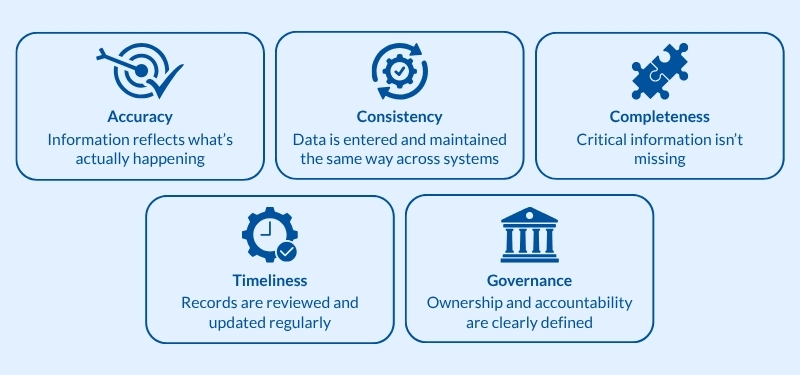
When those fundamentals are in place, a lot of things start to get easier.
Reporting becomes more reliable. Automation becomes more effective. AI becomes more useful. And your team can make decisions with greater confidence.
Getting Started Doesn’t Have to Be Complicated
One of the biggest misconceptions about data hygiene is that it requires a massive cleanup project.
In reality, the best place to start is often with small, consistent improvements.
Clean up duplicate records. Review outdated information. Standardize how data is entered. Define ownership for critical business data. Identify sensitive or regulated data and ensure it is appropriately protected. Establish guardrails around how AI tools interact with company information.
You don’t need perfect data tomorrow. You just need progress.
Because every step toward cleaner, more trustworthy data makes it easier to get value from the technology you’re already investing in.
The Bottom Line
Everyone wants to talk about AI.
But the organizations seeing the greatest success with AI aren’t necessarily the ones with the newest tools. They’re the ones with the strongest foundation behind them.
Good data hygiene isn’t what gets the headlines, but it’s what makes AI work.
So before you ask what AI can do for your business, ask yourself a simpler question:
Is your data ready for it?
Ready to Strengthen Your Data Foundation?
Whether you’re exploring AI, evaluating your current data environment, or trying to figure out where to start, you don’t have to tackle it alone.
At Mirazon, we help organizations cut through the noise, identify opportunities for improvement, and build a stronger foundation for AI, automation, and smarter business decisions.
Download our Data Hygiene Guide and Data Hygiene Checklist to see where your organization stands—and learn what it takes to become truly AI-ready.