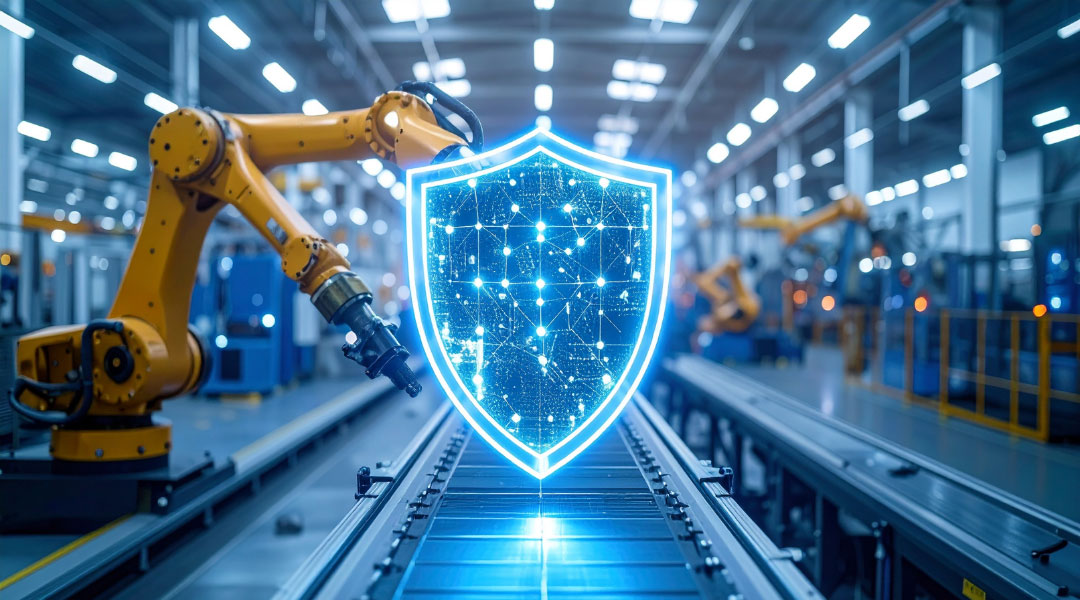
Manufacturers are no longer just building products. They’re managing highly connected, technology-driven environments where a cyberattack can halt production, disrupt supply chains, and impact revenue overnight. And cyber attackers know it.
Manufacturing has become one of the most targeted industries for cyberattacks, with ransomware, supply chain compromises, and operational technology (OT) vulnerabilities leading the way. In fact, ransomware and extortion activity surged significantly in recent years, with manufacturing companies among the most frequently impacted organizations.
The reality is simple: cybersecurity is no longer just an IT issue. It is a business continuity issue.
Why Manufacturing Is a Prime Target
Modern manufacturing environments combine IT systems (email, servers, cloud apps) with operational technology (machines, PLCs, industrial control systems). This combination creates opportunity and risk. Key factors driving cyberattacks include:
- Legacy systems that weren’t designed with today’s security standards in mind
- Highly connected supply chains that expand the attack surface
- Downtime sensitivity, making ransomware more effective
- OT environments where disruption impacts physical operations
Attackers increasingly exploit these realities. Supply chain attacks, for example, allow threat actors to compromise a single vendor and gain access to many downstream manufacturers. At the same time, AI is accelerating how quickly vulnerabilities can be exploited, shrinking response windows for businesses. Learn more about these realities in our Manufacturing, Warehousing, and Logistics (MWL) Survival Guide where we break down how to reduce risk, protect production and keep operations on track.
Below are practical, proven cybersecurity best practices manufacturers should prioritize today.
1. Secure Both IT and OT Environments
Many manufacturers still treat IT and OT as separate worlds. Attackers don’t.
Operational technology (OT) includes the systems that directly control production, such as machines, sensors, and industrial networks. Securing OT is critical because breaches here can stop production or even create safety risks. Best practices include:
- Segment IT and OT networks
- Limit access between environments
- Monitor OT traffic for anomalies
- Apply security controls without disrupting operations
A strong security strategy must account for both digital systems and physical processes.
2. Strengthen Your Supply Chain Security
Your security is only as strong as your weakest vendor. Cybercriminals are increasingly targeting suppliers and software providers to gain indirect access to manufacturers. Recommended best practices include:
- Vet vendors for cybersecurity maturity
- Require security standards in contracts
- Limit third-party access to only what’s necessary
- Continuously monitor vendor risk
This is where many manufacturers are exposed and where proactive oversight makes a major difference.
3. Implement Layered, Defense-in-Depth Security
No single tool will stop modern threats. This is why, at Mirazon, we recommend a layered approach. This means combining multiple security controls that work together:
- Endpoint protection
- Network security (firewalls, segmentation)
- Identity and access management
- Email security and phishing protection
- Backup and disaster recovery
Layered security reduces the likelihood that a single failure leads to a full breach.
4. Prioritize Identity and Access Control
Most breaches don’t start with a sophisticated hack, they start with stolen credentials. Having strong identify and access controls in place for your manufacturing facility is critical. This is where many of the fundamental cyber protections are overlooked or not enforced. We recommend:
- Enforce multi-factor authentication (MFA) across all systems
- Use least privilege access (users only get what they need)
- Monitor for unusual login behavior
- Eliminate shared accounts
Identity is the new perimeter. If attackers gain access to valid credentials, they can often move undetected.
5. Build Resilience Against Ransomware
Ransomware continues to dominate the manufacturing threat landscape, with attacks increasing and becoming more sophisticated. Even more concerning, many organizations that pay ransoms still experience data loss or repeat attacks. Building resilience is important to ensure downtime is mitigated and loss revenues are prevented. You should consider:
- Maintain immutable, tested backups
- Segment networks to contain spread
- Develop and test an incident response plan
- Train employees to recognize phishing attempts
The goal is not just prevention, it’s the ability to recover quickly without paying attackers.
6. Invest in Continuous Monitoring and Detection
It’s no longer realistic to prevent every cyber incident. The focus must shift to early detection and rapid response. Prevention is key and in order to have continuous monitoring, you have to have the right tools and processes in place. We recommend:
- Implement 24/7 monitoring (SOC or managed detection)
- Use threat detection tools across endpoints and networks
- Establish alerting and escalation procedures
- Regularly review logs and activity
The faster you detect a threat, the less damage it can cause.
7. Train Your Workforce
Your employees are your first line of defense and often your biggest risk. It’s essential that your employee base, from frontline workers, to skilled engineers, to facility managers, understand how to spot and report suspicious cyber behavior. Best practices for training includes:
- Conduct regular security awareness training (SAT)
- Simulate phishing attacks
- Educate teams on safe data handling
- Reinforce reporting of suspicious activity
Human error remains one of the most common entry points for attackers, training can help limit your risk.
8. Follow Proven Frameworks and Guidelines
You don’t have to build your cybersecurity program from scratch. Organizations like the U.S. Small Business Administration recommend foundational steps such as:
- Regular software updates and patching
- Strong password policies
- Data backup strategies
- Access control and user management
These fundamentals still stop a large percentage of attacks when consistently applied. At Mirazon, our cybersecurity team works with your leadership and employees to ensure we build the right protections and deploy the right tools to protect and empower your business.
Cybersecurity as a Competitive Advantage
For manufacturers, cybersecurity is no longer just about protection, it’s about performance. The manufacturers that treat cybersecurity as a core business function will be the ones best positioned to grow. Viewing cybersecurity services, tools and people as investments and not just expenses helps reframe how this becomes a competitive advantage for your manufacturing facility. A secure environment enables:
- Reliable production uptime
- Stronger customer trust
- Safer adoption of AI and automation
- Competitive differentiation in the market
Your IT Partner Matters
Cyber threats targeting manufacturers are not slowing down. They are evolving and becoming faster, more targeted, and more disruptive than ever. But with the right strategy, tools, and partners, manufacturers can shift from reactive defense to proactive resilience.
At Mirazon, we help manufacturers secure their environments. Our expertise in working in large warehouses, the factory floor and with complex OT systems allows you to keep production moving and the business growing. Mirazon’s managed service offerings are specifically fitted to manufacturing companies to ensure they have the constant support, protection and peace of mind in todays’ threat landscape. If you are in the manufacturing, logistics or warehousing (MWL) business segment, reach out to us today to learn about our experience and how we can elevate your business.